
Babar Faces Strike-Rate Challenge, Du Plessis Calls for Honest Discussions
97 Repoter: Mohammed Afzal
Publish: 6 months ago Update: 58 minutes ago
Babar Faces Strike-Rate Challenge, Du Plessis Calls for Honest Discussions
Babar Faces Strike-Rate Challenge, Du Plessis Calls for Honest Discussions
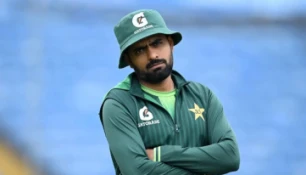
In the ongoing T20 World Cup, Pakistan batter Babar Azam has scored just 66 runs in three innings from five matches, with a strike rate of a little over 115. His average also makes for grim reading, hovering around 22. The highest run-scorer in T20 internationals, Babar’s lean patch has drawn attention, and South African cricketer Faf du Plessis has weighed in on the issue.
Speaking on ESPNcricinfo’s ‘Time Out’ show, du Plessis shared his analysis, touching on the evolution of the game and the changing demands of T20 cricket.
“Great cricketers’ careers evolve in different ways at various stages,” he said. “We know Babar has been one of the best players in the world for many years. But T20 cricket has moved forward very quickly in terms of strike rate, and in that regard he is slightly behind.”
According to du Plessis, the approach to scoring in modern T20 cricket has changed significantly. If a team cannot apply pressure from the start of the innings, it tends to fall behind. In that context, he suggested that Babar’s batting method may need to be reconsidered.
“In my view, if you are Mike Hesson, you are trying to find the best way to utilize him in the game. If the wicket is tricky, someone can bat at a strike rate of 120–130. Hesson might be thinking, ‘How can I get the best out of Babar?’ But the game has moved well beyond a strike rate of 120–130. In the first six overs, you often need 160–190 or even above 200.”
However, he also reminded that not all conditions are the same. On certain types of surfaces, Babar can still be highly effective if used in the right role.
“At these venues and in specific conditions where there is a lot of spin, a batter like him in the middle order can add great value to the team and anchor the innings,” du Plessis said.
He believes the solution lies in honest and direct communication between the player and the coach, with statistics laid out clearly as the foundation for discussion.
“All conversations must start with honesty. That is the core of any discussion. When you are honest, everything flows more smoothly. But if you dance around the issue and, as a coach or captain, do not tell the truth, you end up digging a hole in which the cricketer falls. So the manner of communication is always important.”
He added, “The coach needs to say, ‘Listen, these are the numbers. This is what your statistics are saying. This is where the game is now. If we want to succeed in this World Cup or tournament, we need to be the best in these areas. Or these are the areas where we are weak and need to improve.’ Once that conversation starts, it is very difficult for a player to say, ‘I don’t agree with you.’ At that point, the player has two options: create a major issue or accept reality and work on improving.”
There is no doubt about Babar Azam’s ability. But to meet the demands of the modern T20 game, change seems inevitable. In this fast-paced era of T20 cricket, reinventing himself may be the biggest challenge facing Pakistan’s star batter.